


Most Indians buy a regular inverter for one reason: power cuts. The inverter keeps the lights on when the grid goes down.
But there is a smarter option that does two things at once – keeps the lights on during cuts and reduces your electricity bill every month. It is called a Solar Hybrid PCU.
Here is an honest comparison of both.
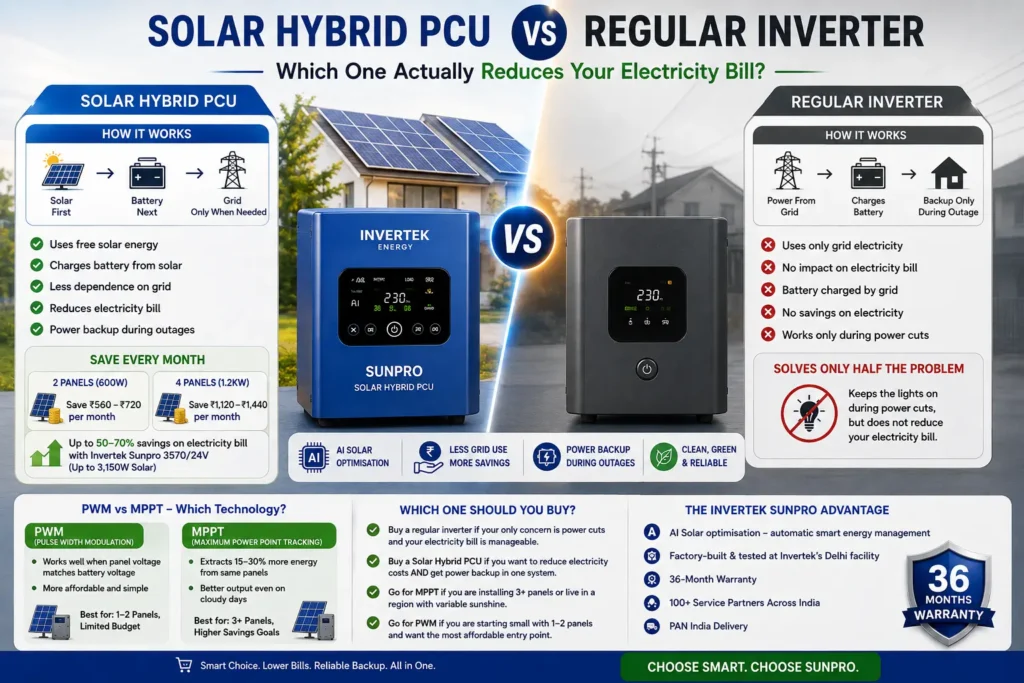
A standard home inverter charges its battery from the grid. When there is a power cut, it switches to battery power.
That is it. Your electricity bill is not affected at all – you still draw everything from the grid when power is available. The inverter only kicks in during outages.
For homes with short, infrequent power cuts, this is a cost-effective solution. For homes with long daily outages or rising electricity bills, it solves only half the problem.
A Solar Hybrid PCU (Power Conditioning Unit) connects to solar panels, a battery, and the grid – all at once.
The priority order is automatic: solar first, then battery, then grid. During daylight hours, your home runs on free solar energy. The battery is charged by solar energy. The grid is used only when solar is insufficient.
The result: you consume less grid electricity every month, which directly reduces your electricity bill.
During power cuts, the system switches to battery – charged by solar, not by the grid you are already paying for.
👉 Explore the Invertek Sunpro Solar Hybrid PCU (MPPT) – built for serious bill reduction.
PWM solar charge controllers are the older technology. They work well when the solar panel voltage matches the battery voltage closely. They are more affordable and simpler.
Best for: smaller solar installations (1–2 panels), limited budgets, basic power backup with some solar benefit.
👉 See the Invertek Sunpro Solar PCU (PWM) range – the most affordable entry point into solar backup.
MPPT technology extracts 15–30% more energy from the same solar panels by continuously adjusting the electrical operating point of the panels.
In practical terms: more solar energy converted to usable power from the same panel setup. Especially valuable on cloudy days and in the early morning and late afternoon when panels are not at peak efficiency.
Best for: 3+ panel installations, serious electricity bill reduction goals, homes in partially cloudy regions.
👉 See the Invertek Sunpro Solar Hybrid PCU (MPPT) – extracts up to 30% more power from the same panels.
Invertek’s Sunpro series comes in both PWM and MPPT versions – from 1kVA to 7.5kVA – so you can match the technology to your actual budget and solar goals.
A standard Indian family uses approximately 300–400 units of electricity per month. At the national average of ₹7–₹8 per unit, that is ₹2,100–₹3,200 per month.
| Solar Setup | Monthly Units Generated | Monthly Savings |
|---|---|---|
| 2 panels (600W) | 80–90 units | ₹560–₹720 |
| 4 panels (1.2kW) | 160–180 units | ₹1,120–₹1,440 |
| Sunpro 3570/24V (3.15kW) | 400–500 units | ₹2,800–₹4,000 |
The Invertek Sunpro 3570/24V supports panels up to 3,150 watts. At that size, most families can reduce their electricity bills by 50–70% within the first year.
All Sunpro models come with AI Solar optimisation that adjusts charging and usage automatically throughout the day. The system tracks solar generation, battery state, and load in real time – without any manual setting.
Every Sunpro unit is factory-built and tested at Invertek’s Delhi facility. 36-month warranty. PAN India delivery. 100+ service partners.
For the best results, pair your Sunpro PCU with high-efficiency Invertek Mono Solar Panels – engineered to maximise generation even in low-light conditions.
1. What is the difference between a regular inverter and a Solar Hybrid PCU?
A regular inverter only provides power backup during grid outages – it does not reduce your electricity bill. A Solar Hybrid PCU does both: it runs your home on solar energy during the day to cut your monthly bill, and switches to battery during power cuts.
2. Can a Solar Hybrid PCU work without solar panels?
Yes. If solar panels are not installed yet, the Sunpro PCU will function as a regular inverter – charging from the grid and providing backup during cuts. You can add solar panels later and the system will automatically start prioritising solar power.
3. Which is better for my home – PWM or MPPT?
If you are installing 1–2 solar panels and want an affordable entry point, PWM is sufficient. If you are installing 3 or more panels, or live in a region with variable sunshine, MPPT will extract 15–30% more energy from the same panels and give you better long-term savings.
4. How long does it take to recover the cost of a Solar Hybrid PCU?
For most Indian households, the payback period is 2–4 years depending on your electricity tariff, daily usage, and number of panels installed. After that, the electricity savings are essentially free returns for the remaining life of the system.
5. Does the Invertek Sunpro work during both power cuts and daytime simultaneously?
Yes. The Sunpro PCU manages solar input, battery state, and grid availability in real time using AI Solar optimisation. During the day it runs your home on solar, charges the battery, and keeps the grid as a backup – all automatically with no manual switching required.
6. What warranty does the Invertek Sunpro series come with?
All Invertek Sunpro Solar Hybrid PCU models come with a 36-month manufacturer warranty, PAN India delivery, and access to 100+ service partners across the country.
Product Catalogues
Useful Links
Become a Partner
Support
Track your Order
Get In Touch

Secure Payment:


Sevenpeaks Solutions Online Ecom Distributor of Invertek Energy