


Walk into any inverter shop in India and the dealer will probably push tubular batteries at you. They’re cheap upfront, familiar, and easy to sell.
But the market is changing fast. Lithium batteries, LiFePO4 are no longer a premium luxury. They are increasingly the smarter financial decision over 5 to 10 years.
Here is an honest comparison of both lithium vs lead acid inverter battery.
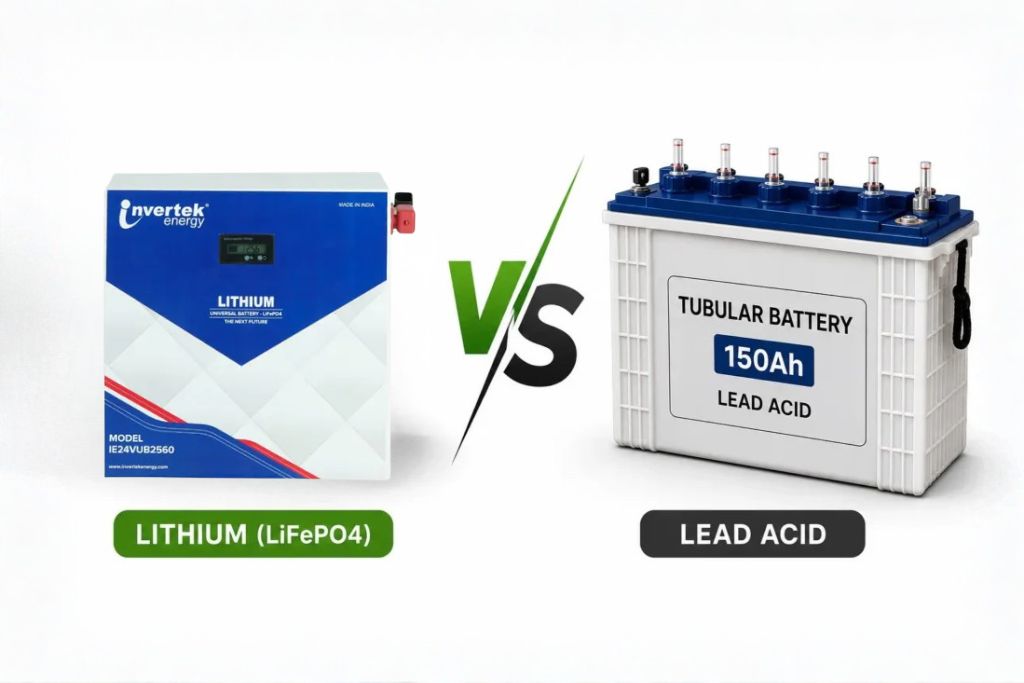
Lead acid batteries have powered Indian homes for decades. Tubular batteries – the tall ones you see in most inverter setups, use a flooded electrolyte design. They work well, they are affordable, and every service centre in India knows how to handle them.
But they require maintenance. Water levels need topping up every few months. They off-gas hydrogen during charging. They corrode over time. And most importantly, they discharge to only 40-50% of their stated capacity before the inverter shuts off to protect them.
LiFePO4 is the safest lithium chemistry for home use. Unlike cobalt-based lithium batteries, it does not overheat or catch fire under normal use. It is stable, reliable, and built for the repeated charge cycles that a home inverter system demands.
You can discharge it to 80-90% without damaging it. No water top-ups. No hydrogen gas. No corrosion. A battery management system (BMS) handles everything automatically.
This is where the conversation changes for most buyers.
The lithium battery costs more upfront. It costs significantly less over the decade.
A 150Ah lead acid battery delivers approximately 75Ah of usable energy (50% depth of discharge). A 100Ah LiFePO4 delivers approximately 80–90Ah of usable energy.
In practical terms, they give similar backup. But the lithium battery is smaller, lighter, and can be wall-mounted, no floor trolley required.
Lead acid batteries take 8–12 hours for a full charge. LiFePO4 batteries charge in 3–5 hours depending on the charger. In areas with frequent short power cuts – 2 hours off, 2 hours on – lithium gets you back to full capacity while lead acid is still at 60%.
Lead acid batteries degrade faster in heat. In Indian summers, especially North India where temperatures cross 45°C – tubular battery life can drop to under 3 years. LiFePO4 is significantly more heat-stable.
Invertek’s LiFePO4 batteries (PRETON+ range) are drop-in compatible with all Rapid+ 1050 and above inverters. Automatic charge profile detection means there is no manual configuration. The Invertek Li+UPS series takes this further, the inverter and lithium battery are built into one wall-mounted unit. No separate battery trolley. No floor space. No water. Both the standalone LiFePO4 battery and the Li+UPS come with 36-month warranty and 100+ service centres across India.
Product Catalogues
Useful Links
Become a Partner
Support
Track your Order
Get In Touch

Secure Payment:


Sevenpeaks Solutions Online Ecom Distributor of Invertek Energy